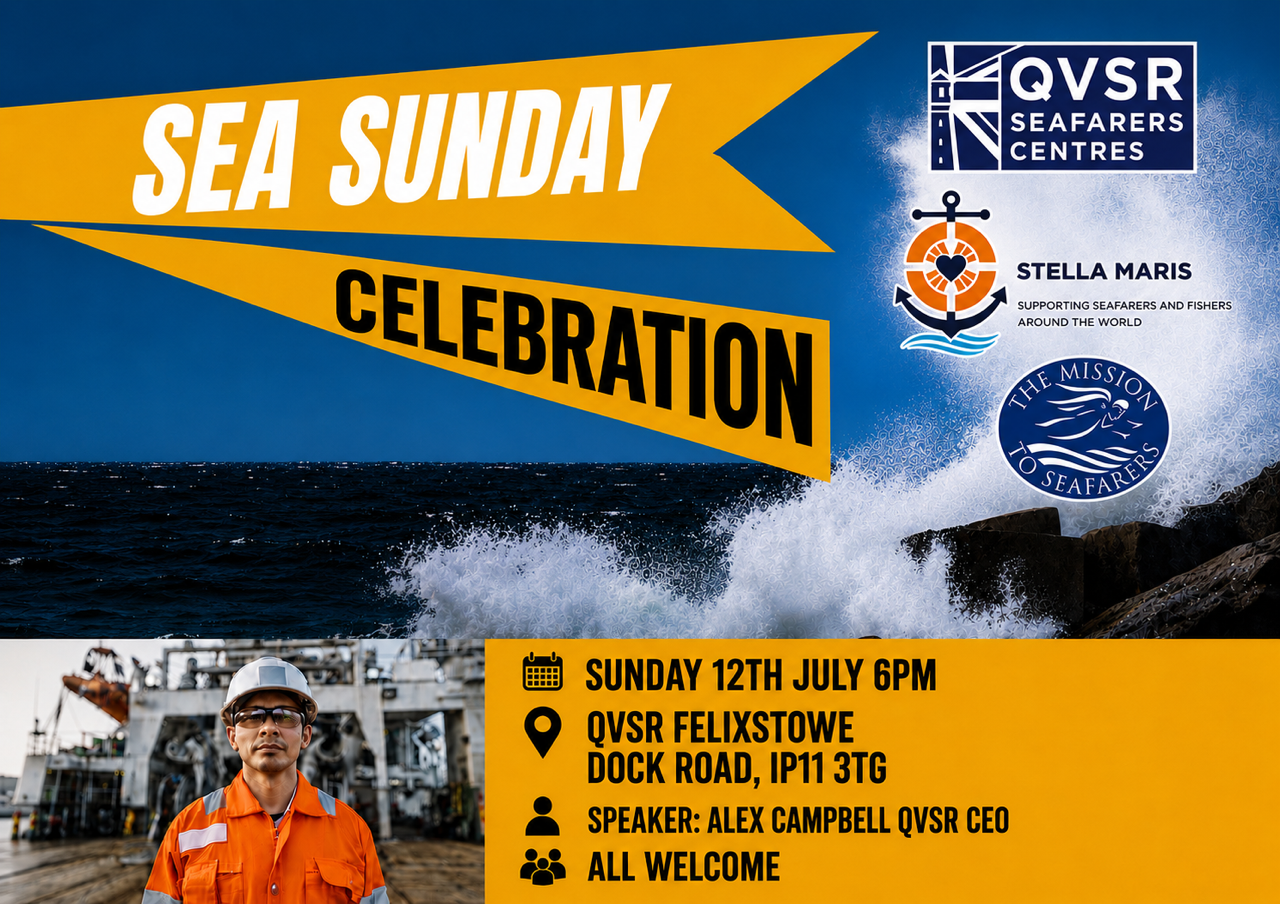
By popular request we are commencing a Sunday evening Praise and Worship service at the Seafarers Centre on Felixstowe Dock. Everyone is welcome to attend. For further details ring 07519 043580

By popular request we are commencing a Sunday evening Praise and Worship service at the Seafarers Centre on Felixstowe Dock. Everyone is welcome to attend. For further details ring 07519 043580

Alexander Campbell OBE took over the helm of QVSR in June 2003 and over the last 22 years has led the development of a new vision and direction for the charity, championing the needs of both active and retired seafarers, veterans of the Armed Forces and other individuals who find themselves homeless.
The “Queen Vic” has had a strong reputation for serving those in need for over 180 years and Alexander has continued to develop this by being at the forefront of establishing imaginative new services aimed at reaching out to people and helping them to rebuild their lives and discover new opportunities. Under his watch the QVSR accommodation building in Poplar, in the East of London, has been completely transformed through an £8 million redevelopment programme with the aim to always put “Residents First”.
Alexander has also been instrumental in re-establishing our maritime heritage. In 2022 the creation of a new subsidiary charitable company, “QVSR Seafarers Centres”, expanded QVSR’s port based welfare services beyond the Port of London, Tilbury and DP World London Gateway, to the London Cruise Terminal and the ports of Bristol, Felixstowe and Immingham. This expansion continues the work first set out by our founders in 1843 and aims to always put “Seafarers First”.
Alexander was born and educated in Scotland and studied at the University of Dundee where he gained a BA in Professional Studies and an MSc in Leadership and Organisational Development, he also holds a NVQ 4 and NVQ 5 in Strategic Management and is a Chartered Manager and a Fellow of the Chartered Management Institute. In the 2020 Queen’s Birthday Honours List, he was awarded an OBE for his charity work which spans over three decades; most of which has been spent working with frontline homeless services and housing associations.
Driven by a passionate commitment to give new opportunities to vulnerable groups including homeless people, Alexander’s varied career has given him rich experience of working in the heart of excluded communities across the country, including London, Portsmouth, Leicester, Liverpool, Glasgow and Inverness. His desire is to help the marginalised find a route back into the heart of society.
Alexander lives in Essex with his wife Ruth and children, he enjoys travelling and music making through his passion for brass bands. Alexander is a Magistrate and a Trustee of Methodist Ministers Housing Society (MMHS).
In November 2014, Alexander was honoured to receive the Merchant Navy Medal for services to the care and welfare of retired merchant seafarers, Honoris Causa.

Margaret Condick
Margaret died on 14th March. She would have been 80 in November. But what an active life she led – a physics graduate who ended up teaching Maths, a wife and a mother of a devoted family, she will be sadly missed.
I knew Margaret through many of her voluntary roles. We were school governors together, and served on an appointment panel to appoint a new head teacher. Margaret was involved in local politics, and was still serving as Treasurer of the local Liberal Democrats branch up to the time of her death. But it was through her work with Churches Together that I really got to know her, and to appreciate her administrative skills and learn from her vast experience of church life. Some of this was summed up well in her daughter’s eulogy at her thanksgiving service at Kirton Church in April.
Mum was heavily involved with the church. This was initially helping with church cleaning, church flowers and the church library when we were young but as time went on this developed into getting more involved with the church organisation. She was voted onto the General Synod in 2003 and served as a lay representative until 2015. During her time there she regularly spoke on issues she felt strongly about: female bishops, ensuring wording was written in inclusive language and supporting rural communities for example. She was very proud that some of her speeches got enthusiastic backing from the audience by addressing points that the majority of people were ignoring or hadn’t noticed.
Following her time on general synod Margaret become the County Ecumenical Officer for Suffolk, facilitating links between churches and producing directories with contact details for all churches in Suffolk. She also became very involved with Churches Together in Felixstowe, Churches Together in Suffolk, Deanery Synod and the Affirming Catholicism group – often in roles utilising her organisational and clerical skills.
Margaret was employed part-time for a while by Churches Together in Suffolk, and produced their regular newsletters, though she always felt that nowhere else in the county were the churches as well organised as Felixstowe. She had been a founder member of CTF, in 1992, and served for many years in key roles: on the Enabling Group, as Minutes Secretary, as Secretary, as Treasurer and for a while as Moderator. Our present constitution owes much to her redrafting skills.
Margaret was a curious mixture of a traditionalist and a progressive. She preferred the older hymns and the liturgical structures of Anglicanism, but was also a champion of the roles of women in the church. She loved things to be done decently and in order, but her mathematical mind led her to question how we sometimes ordered things. The reason why the service sheets we have used at the Triangle on Good Fridays, and before that at Unity Services are A4 sheets folded vertically is because of her observation that most songs do not go right across the page, and paper could be saved by keeping them all in single columns on paper that was not folded to make A5 pages. And the song sheets were easier to hold.
Her ability to think outside the box showed up in other ways. I can remember a Trimley St Martin School governors meeting where she came up with a solution to a long-standing traffic problem. Parents’ cars at the end of the school day blocked the road; Margaret suggested having intermittent yellow lines which created spaces between parked cars so that others could pass. It worked. Every time I drive up the Kirton Road past the primary school, I am reminded of Margaret.
Many of us will have special memories of Margaret. Our thoughts and prayers will be with her husband Noel and all their family.
Andrew Marfleet, May 2024